


















On Tuesday Oct. 1, National Bunraku Theater set the scene for a fascinating production of Japanese puppet theater. The term Bunraku is usually used to refer to traditional Japanese theater, specifically the productions that have three-person puppet manipulation. With a brief 20-minute intermission, there were two plays performed called “Date Musume Koi no Higanoko” (“Oshichi, the Greengrocer’s Daughter”) and “Sonezaki Shinju” (“The Love Suicides at Sonezaki”). I attended the performance late Tuesday night, and with this being the first time I attended this sort of presentational drama with a three-person controlled puppet, I will admit that I was slightly confused.
The first play opened with an escalation of live music being performed to the right of the stage. Oshichi, the main character in this climactic “The Fire Watchtower” scene of the play, climbs the watchtower and beats the fire drums in an attempt to open the gates to the city and help her lover, Kichisaburo, find the whereabouts of a treasured sword. As the story was being told, there were English subtitles being projected onto the top of the stage for the audience to follow. Although following the story through the subtitles was necessary to understand the general plot, I personally felt the escalation of music contributed more to my comprehension of the scenes from an emotional perspective.
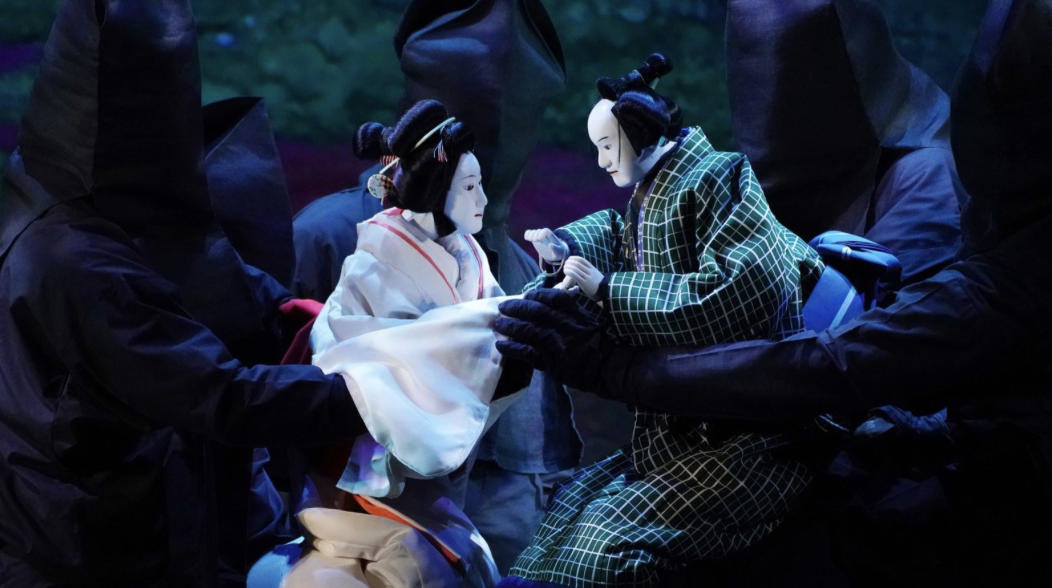
The second play follows the story of Tokubei and Ohatsu, a couple with the intention of committing suicide in hopes of being reunited in their afterlife. I thought that the entirety of their story was much more complex in a way that it left me thinking about their actions leaving the theater that night. There was so much emotion put into the scenes through the mechanisms of the puppets and at moments, it felt like I was inside their minds perceiving their devotion to do anything to be together.
The visuals were spectacular with a projection of the night sky above a pond reflecting the Big Dipper and Milky Way. They proclaimed their love by exchanging their wedding vows on the bridge set above this pond, setting the story for the audience through a dramatic exploration of their everlasting connection. Through a performance of desperation and self-reflection, their suicides were brilliantly depicted with a mix of passion and recklessness. Reflecting on the plot, it really made me think about the internal adversity I would face if I were to be in their position which I believe was placed into my head because of the humanity of the puppets.
None of these emotions would have been possible to convey without the three puppeteers who specialized in the manipulation of the limbs and facial expressions. Before the intermission, there was a short period where the puppeteers came onto the stage to explore these mechanisms and reveal the development of sophistication within the entire operation. Their presentation explored the ways in which the puppets operate in terms of the movement of their limbs and how the complexity of these actions plays into the entire articulation of their figures.
What was interesting to me was the presentation of the thread used to move the head of the puppet up and down and the way they also control the facial expressions. They showed how there are two ways to change the expression of the puppet with one being the movement of their eyebrows and the other being their gaze. They also showed the way in which the three puppeteers are divided in their roles to articulate the puppet, and how each of their roles is vital to make the puppet move smoothly.
Before this performance, I have only ever watched one-person puppet performances which now looking back, had much less thought and articulation put into them. Learning that it takes years for these puppeteers to master the skills needed to move the limbs, I was incredibly impressed.
At one point, they explained how for male puppets, they use wooden legs to show them walking but for females, there are no legs so the operator has to manually hold the fabric in a specific way to manipulate the movements and simulate the appearance of a leg.
Overall these haunting yet intriguing performances both delved into the complexities of love and through the puppets’ determination to achieve a sense of closure and understanding amongst themselves and their partners, I was really able to immerse myself into the experience and establish a clearer understanding of the plot. It was impeccable to observe how the audience can gain so much insight from just paying simple attention to body language and connecting it to shifts in emotion.National Bunraku Theater: Japanese Puppet

