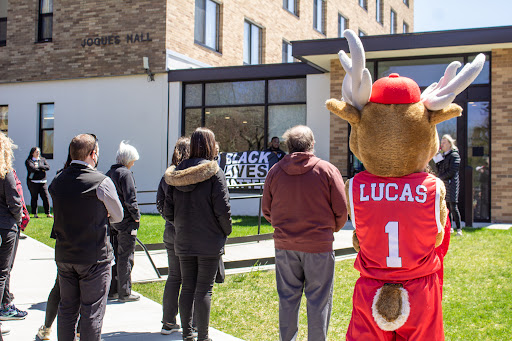



















At the heart of the Jesuit mission is a commitment to justice. As members of the community of Fairfield and surrounding areas, we are called to act upon the teachings of Dr. Martin Luther King, Jr. He envisioned a Beloved Community built on agape, a disinterested, nonreciprocal love seeking nothing in return. This year’s MLK Convocation, honoring Edwidge Danticat, reinforces the notion that racial justice is an ongoing demand that asks us to consider our commitment to equality.
Danticat’s address was a powerful refusal to let the suffering of her ancestors and countless others be forgotten. Through her literary works and MLK Convocation speech, she highlighted Haiti’s hard-fought independence and the lasting consequences of troubled history on Haitian people. She emphasized the resilience of her homeland, Port-au-Prince, in facing colonialism, political turmoil, and natural disasters. The devastating 2010 earthquake left thousands dead and millions without homes, including Danticat’s family.
Across American history, Haitian culture has been misrepresented and marginalized. In his 1965 Let My People Go speech, Dr. King stated, “Africa has been depicted for more than a century as the home of black cannibals and ignorant primitives. Despite the volumes of facts contraverting this picture, the stereotype persists in books, motion pictures, and other media of communication.” Despite the awareness Dr. King raised about racial equality, Haiti continues to be a target of prejudice. From Thomas Jefferson’s racist rhetoric and the United States occupation from 1915-1934 to more recent discrimination, Edwidge Danticat has pointed out derogatory remarks including President Trump’s infamous depiction of Haiti as a “shithole country” and false claims about Haitian immigrants eating domestic cats and dogs in Springfield, Ohio.
What many do not remember is that Haitian soldiers fought alongside American troops during the American Revolution. Yet, despite this shared history, Haiti has been forgotten. In 2025, the world will mark the 200th anniversary of Haiti’s independence debt to France, a financial burden that kept the nation impoverished for two centuries.
More recently, injustices against Haitians have persisted. In October 2024, Edwidge Danticat’s uncle, Reverend Joseph Dantica, flew from Haiti to Miami, Florida. Despite possessing a valid visa, he was detained at the Miami International Airport after requesting temporary asylum. According to Danticat, officials confiscated his medicine, and he died “shackled to a bed” just five days after arriving in the U.S. However, the Department of Homeland Security’s Immigration and Customs Enforcement division denied any wrongdoing, relaying an autopsy report that attributed his death to pancreatitis, and dismissed any connection to his detainment.
Over a million Haitian Americans live in the United States. “Milk and honey” flowing in the streets might be easy to discuss, but as Dr. King urged, we must be concerned with those in need – those without homes, food, healthcare, security, opportunity, education, family and hope. We must ask the important questions to uncover the difficult yet necessary answers.
Danticat, referencing Toni Morrison, explains that the function of racism is to serve as a distraction, forcing marginalized people to justify their existence instead of pursuing their full potential. Our focus must remain on social justice. We must demand empathy, compassion, and action. We have to challenge the systems that promote injustice and listen to the voices of those who have been silenced. We must reject the misguided notion that division is beyond our control.
“Only when it is dark enough can you see the stars,” Dr. King once said. In honoring his legacy and amplifying the voice of Edwidge Danticat, we must recognize that the fight for racial justice is far from over. We are called to embrace the opportunity to do more. Will you answer?