




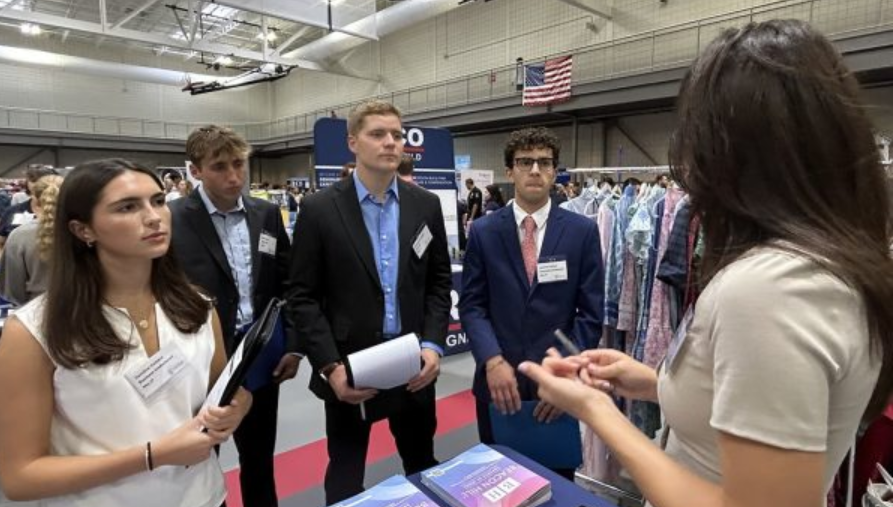
With the increased usage of AI in the workplace and the job search, the Career Fair is changing. Amna Haider, the Director of Data Management and Enrollment at Fairfield Meditz, is teaching students how to use it to their benefit.
Fairfield University’s 2026 Spring Career and Internship Fair is today, from noon to 3 p.m., in the RecPlex.
The fair will be attended by over 75 employers from Connecticut and the surrounding area, covering a broad range of occupations, including financial services, media and communications, and educational institutions.
Haider, in her Digital Edge Seminar, discusses data concepts, how to exist in a data-driven economy, and how to use data tools, namely, AI. “Job hunting [with AI] is very different now…everyone is looking for tech tools. In the skills section of your resume you can [include] AI, but AI is a really broad term,” she said. It’s important to have other specific AI-related skills, such as integrating it or using it for a select purpose.
Haider attests that students who use AI will have different takeaways from the Career Fair, because AI programs are able to give potential employees valuable insights about the company or their hiring process that employers may not have off the top of their heads. She also added that, “If you have a really niche interest, you can build on it. [AI] is exposure to everything that exists, and it lies within the individual to bring it all together.”
However, it is essential that AI is used wisely. “When I was working in hiring, people sent in their AI resumes and cover letters, but [where it says] insert name here, [they left it blank]. So [when you’re using] in that regard, you’re making a really nice cover letter, but then you miss that piece. That’s going to be a detriment to you,” Haider said.
Finally, AI can give students an advantage in the job search. “If you’re not using AI to [help with what] you’re trying to search for, you’re automatically spending a lot more time [on that] than someone who is using AI,” she said. “If they already have [those insights], wouldn’t they automatically have an edge?”
For students who aren’t using AI, it’s not something to be scared of. Haider vouches for its value and support, saying, “…others are using it all the time. Computers are quicker than humans are.”
The event will be chock-full of opportunities and people looking to connect, so proper preparation is essential. The best way to prepare for the career fair is to take advantage of the on-campus career centers, says Meditz College Career Development Advisor, Yamil Cobo. He went on to describe the different career centers Fairfield University has, saying, “We have a desynchronized career center, so that means that each college has its own career center. [We also] have the [main] career center. The best way to take advantage of your career center is by going to the drop-in hours and events.”
Cobo also discussed what attendees should wear, harping on the importance of professional attire, and recommended a suit as the best option. He also shared information regarding a resource students can use if they need clothing items for events like these: the Career Closet. Students can make an appointment and borrow professional attire for the events they will be attending.
Something else students should do to be prepared for the Career Fair is to have copies of their resumes ready. Cobo stated that he tells students to visit the university’s Handshake (a career management and job networking platform) profile and scan the list of employers who will be present at the fair. “I typically tell students [to bring] 10 copies [of their resume]. If you’re planning to talk to more people, [bring] more; if you’re planning to talk to fewer people, I would still bring 10 just in case; you never know who you run into!” he said.
When students enter the Career Fair, there will be a printer on the right-hand side. There, students will be able to print out more copies of their resumes.
The Career Center helps students develop skills they will need for Career Fairs, interviews, and beyond, such as creating a sound elevator pitch. “An elevator pitch is a really crucial thing that a lot of students seem to miss. It’s super important because [in] those first 30 seconds when you introduce yourself and how strong you start builds confidence,” Cobo said.
He recommends that students visit the Career Center during advisor drop-in hours (found on Life@Fairfield) to practice and polish up their elevator pitches.
He added that students who do research will be at an advantage because they’ll know who they’re looking for, and they’ll have mission statements that will likely impress employers. Cobo is an alumnus of the university, and he got his first job from the Career Fair. He tells his students, “The Career Fair works wonders if you do [these things].”
When asked what students should expect from the Career Fair, Cobo claimed it depended on how many times they had experienced the fair. A first-year experience will be different from that of a senior, he said, because while first-year students are there to get acquainted with the career space, seniors are most often there for jobs.
“There are three different avenues students will typically come across at the Career Fair: networking, internships, and jobs,” Cobo said. “Having a friendly smile, giving out resumes, and making sure that you’re proactive and always sending follow-ups to the employers that you talk to is a great way to get started, and then when [you’re] asking for internships, [you] can be a little more inquisitive. ‘What is a day in the life like for this intern?’ ‘What is this company about?’”
In terms of jobs, he says the approach is very similar to that of obtaining an internship, but being “…deliberate with how you are answering questions and how you are following up,” is key. For seniors, this fair may be the last one they attend before they graduate, so getting a job opportunity from the Career Fair would do them a great deal of good.
First-year Brooke Gori said she wants to attend the Career Fair because she thinks it’s a good resource to find information regarding job opportunities. “It’s a good opportunity for [my] future, which I find very valuable.”
A final piece of advice Cobo offered to those attending the fair was simple: just be yourself. “You [have] to realize, from an employer’s perspective, they just want to talk to a human. They want to talk to and get to know [that student]. So, I think personality is the best thing to make that conversation as natural and as authentic as possible.”
Additionally, he said that students should talk to as many employers as possible, even if they’re not interested in that field, because the stakes are lower, and they will likely walk away with new information.
For the complete list of employers, please visit Fairfield University’s Handshake profile. https://fairfield.joinhandshake.com/stu/career_fairs/59225/employers_list?page=1&per_page=25.
