



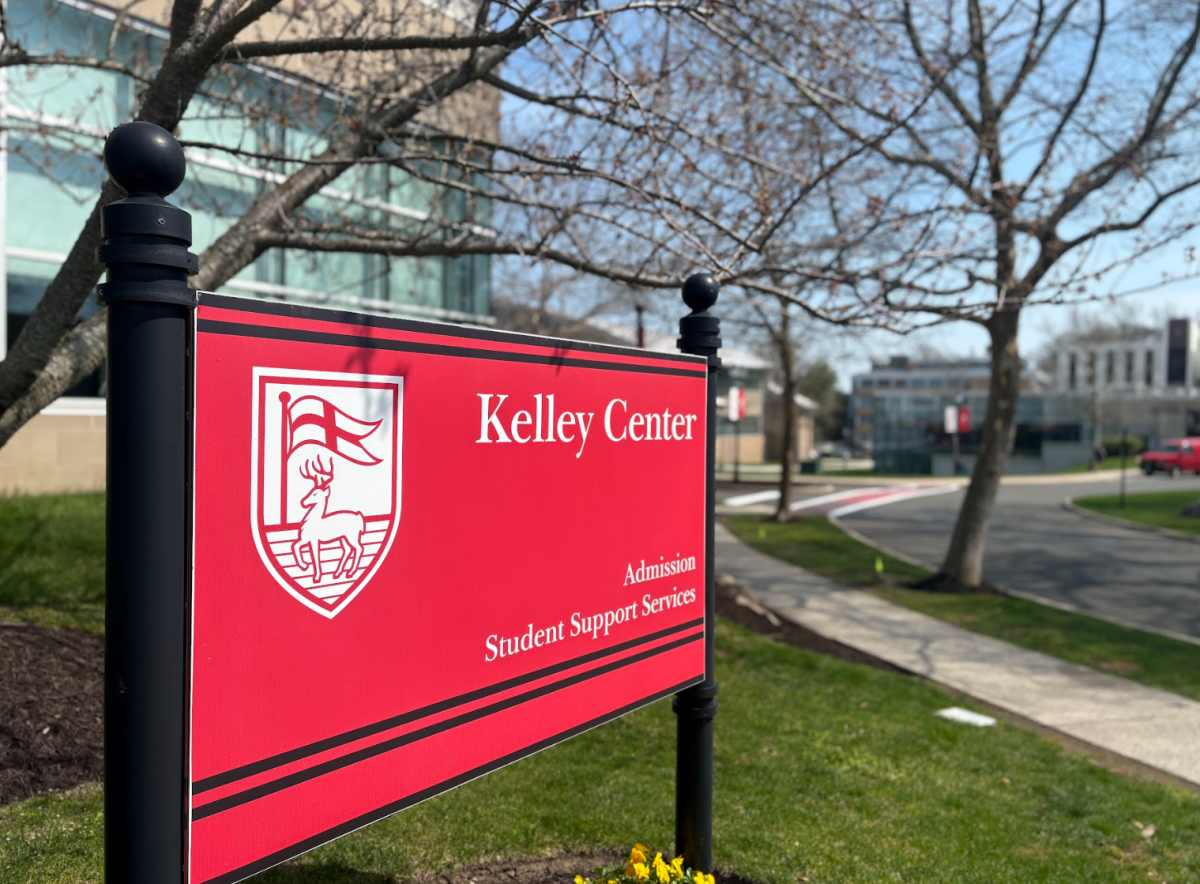







Six unlit candles sat at the front of the room, placed carefully on a table facing a relatively full audience inside the Kelley Center Presentation Room at Fairfield University. As students, faculty, campus ministry and community members settled into their seats on April 16 at 3pm, the quiet anticipation reflected the weight of what the ceremony would soon honor.
The memory of six million lives lost in the Holocaust.
The Holocaust Remembrance Ceremony centered on reflection, education, and the enduring responsibility of memory, featuring keynote speaker Dr. Shay Pilnik, director of the Emil A. and Jenny Fish Center for Holocaust and Genocide Studies at Yeshiva University.
Dr. Pilnik, a scholar of Holocaust memory and postwar Eastern Europe, grounded his remarks in a central idea that framed the afternoon.
“Memory depends on history, and history depends on memory,” Pilnik said, emphasizing how remembrance is essential to preserving the truth.
His talk drew from his recent work on Babyn Yar, the site of one of the largest mass shootings of the Holocaust and explored how its history was suppressed for decades under Soviet rule. Pilnik highlighted the importance of the period known as Khrushchev’s Thaw, when restrictions on public discourse loosened and acknowledgment of atrocities slowly began to surface.
He pointed to 1966 as a significant turning point, marking the creation of one of the first memorials at Babyn Yar, an example of how societies begin to confront and institutionalize memory after long periods of silence.
The ceremony blended historical insight with ritual and reflection. It opened with a prayer led by Fairfield’s Reverend John Savard, inviting attendees to reflect not only on the six million Jewish victims of the Holocaust, but also the millions of others persecuted under Nazi rule.
Moments of silence and prayer were interwoven throughout the program. During the recitation of the Kaddish, the traditional Jewish prayer for the dead, attendees stood together in remembrance. Organizers emphasized that the Kaddish is not solely a prayer of mourning, but also an affirmation of faith and continuity.
This program broadened the scope of remembrance through selected readings. A passage from German pastor Martin Niemöller, served as a stark warning about the consequences of silence in the face of injustice.
“Then they came for me, and there was no one left to speak out for me,” the reading concluded, reinforcing the moral responsibility to act.
Another key moment came during the “Prayer of Resolve,” written by Rabbi David Katz and read by Fairfield Provost, Dr. Christine Siegel. The prayer urged attendees to carry the lessons of the Holocaust forward in their own lives.
“We pray that the lessons we learn from this darkest hour allow all of humanity to better itself,” Dr. Siegel stated, “and to truly and nobly embody the idea that we are each made in Your image.”
Music added another emotional layer to the ceremony. A performance of “Eli, Eli,” based on the words of Hungarian Jewish resistance fighter Hannah Senesh, expressed a longing for continuity and hope, even in the face of immense loss.
One of the most powerful and symbolic moments came when the six candles at the front of the room were finally lit. Each flame represented one million Jewish lives lost during the Holocaust. As the candles flickered, a reflection honored not only those who were killed, but the lives they might have lived.
The ceremony emphasized that remembrance extends beyond acknowledging the past; it is also about recognizing the potential that was destroyed and the responsibility to preserve human dignity moving forward.
As the ceremony closed Fairfield’s, Reverend Paul Rourke delivered the final blessing, reinforcing the ceremony’s central message of remembrance and responsibility.
“We pray for shalom—for wholeness and peace—to be in our midst, now and forever,” Rourke said. “Please, bring us a world devoid of hatred, filled instead with peace.”
In bringing together scholarship, prayer, and reflection, the ceremony highlighted a clear message: remembrance is not just about honoring the past, it is about shaping the future.