








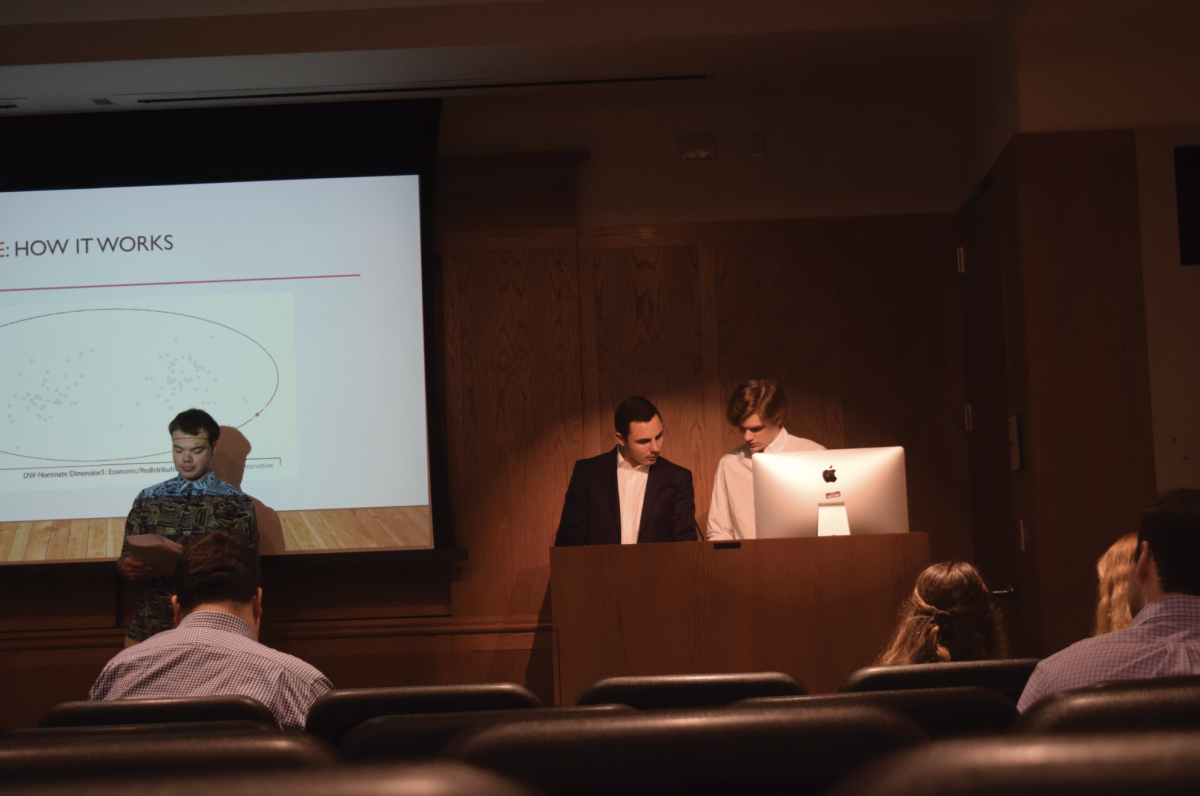
The DiMenna-Nyselius Library’s Multimedia Auditorium transformed into the Capitol Building on the afternoon of Saturday, April 6, when Visiting Professor of Politics Aaron Weinstein, Ph.D., and his United States Congress class simulated a Senate meeting in which students played real senators as they debated a bill related to the second amendment.
The class sat according to caucus, with seven Democrats on the left side of the room and seven Republicans on the right. With the Republicans being the majority, they presented their bill, which would be marked up over the course of the meeting. The Democrats, being the minority, spent time strategizing ways to make sure their bill would be heard.
Students Edward Burchell ‘20, Sam Longworth ‘21, and Logan Giles ‘20, playing Senators Ted Cruz (R-Texas), Benjamin E. Sasse (R-Nebraska) and Lindsey Graham (R-South Carolina) respectively, presented the bill, which they called “Self-Defense and Family Protection Act of 2019.” The proposed bill was a combination of existing laws, including the Stand Your Ground Law that is currently in effect in 22 states.
Two expert witnesses, law enforcement retiree Dan Betteker and Fairfield University faculty member and director of the writing center, Beth H. Boquet, Ph.D. were in attendance. Both used their real names and histories for the simulation, but their testimonies did not necessarily reflect their real political views. They were brought to the stand as expert witnesses on the topic of guns. Each gave a five minute introduction, after which each senator was allowed two minutes to ask questions.
When asking questions, each student embodied the persona of their real-life senator. For example, when Noelle Guerrera ‘21 asked a question from the perspective of Senator Marsha Blackburn (R-Tennessee), she prefaced it by saying, ”Being born and raised in the beautiful state of Tennessee,” before asking Betteker about the details of a gun buyback program. The class would often laugh a little whenever a student would say something very close to what their senator would say in real life, especially if it contrasted heavily with the student’s own beliefs.
When asked about the simulation, Weinstein said, “It’s going even better than I’d hoped. The students are asking informed questions, and they’re being compassionate; they’re being direct. They’re asking tough questions, but they’re also engaging with the roles, which was the hope because, a lot of these students, if they’re playing a Republican, they might be a Democrat, or they might be a Democrat playing a Republican. You know, it’s teaching them to sympathize with other opinions.”
“I want to be a politics major,” said Melyssa Gagliardi ‘22. “So hearing from people who are professionals and who know very much about this topic is definitely enhancing my learning.” Gagliardi was playing the role of Senator Kamala Harris (D-California), so she along with her peers cross-examined the witnesses while also trying to make sure their own bill wasn’t quashed by the simulated turning wheels of congressional procedures.
“I think it’s a great experience,” said Boquet. “It’s been very interesting to learn a little more about how this process works and to see people taking the role of various senators.”
“I follow politics, and gun rights is a hot-button issue in America today and has been for a long time,” said Betteker. “This sounded like a great idea to help the students, and I think I got as much out of it as they did.”S