













The traditional snow day is a dying species, but it doesn’t have to be. Growing up, I’m sure we all experienced the joy and wonder that comes with a snow day. One, two and maybe more (if you’re lucky) days of the school year would be blocked out of the school calendar because of heavy snow and icy roads. But in recent years, the traditional snow day has been put in danger of being erased forever due to the after-effects of the COVID-19 pandemic. As we all know, the pandemic introduced the concept of virtual learning. After schooling returned to normal, virtual learning was added as a key component of snow days. In my opinion, this shift has taken away the full magic of what snow days used to be, and now is the most pivotal moment to change it.
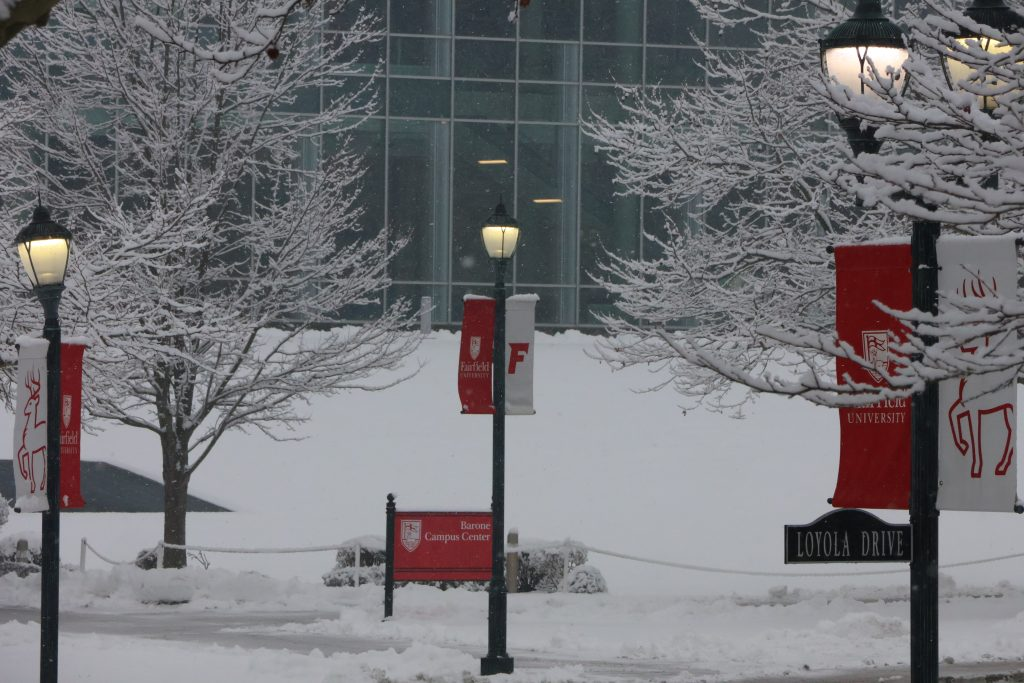
Fairfield University had its first snow day of the 2025-2026 school year on Jan. 26, a Monday. All in-person classes were cancelled, and students were advised by a Stag Alert on Jan. 23 to “refer to their syllabi and/or messages from their instructors regarding alternatives to in-person class meetings.”
Back when I was in grade school, snow days were some of the most anticipated days of the year because they were an unexpected break filled with the joy of watching and playing in the snow as it fell outside. As a kid, I would take part in snow day rituals the night before a snowstorm in hopes that my little contribution would increase the snowfall by tenfold. I would place a spoon under my pillow, wear my pajamas inside out and even flush ice cubes down the toilet. Did any of these rituals change the forecast for the next morning? No. But it was never really about the meteorological data. It was about the belief in something bigger than myself and the hope that I could contribute in some part to the magic of waking up, seeing snow layer the ground, and knowing that the world was my oyster for the day.
If you take that same scene and instead replace your traditional snow day with a virtual learning day, the magic disappears somewhat. Snow may be piled high all around them, but students are still mentally stuck in school through virtual means. The only thing that separates a virtual learning day from a regular school day is location, and in some cases, the activities and length of classes. By default, virtual learning days do not carry any of the same enchantment that traditional snow days do.
As I moved from grade school to high school, snow days shifted from days of relaxation to days dedicated to catching up on work. By the time I was in high school, the pandemic was already digging its claws into the snow day culture. My snow days were filled with assignments, Zoom meetings and Google Classroom posts. I felt too overwhelmed making sure I could finish all the work I needed to complete to even take a moment to enjoy the snow, let alone go outside and appreciate it. While it was fun to be home on snow days, the feeling of dread knowing that I would always have some work to complete never left me.
Now in college, snow days have changed once again for me. While the burden of having to do work for seven high school classes during a snow day has lifted, the expectations have not. On this most recent snow day, I was expected to still sit in front of my camera and attend my scheduled classes via Zoom calls until Wi-Fi issues resulted in their cancellation. In this case, I got lucky, but many of my fellow students were not so fortunate. To make up for this lost time, I was given extra schoolwork to keep on pace with the syllabus, and my hopes of a free day faded away. However, I was determined to still enjoy some of it and put all my effort into completing everything early in the day. My reward was going sledding with my friends on the library hill on Monday afternoon. At last, this snow day felt like one of those magical snow days from my past.
Yet, I couldn’t get the thought out of my head that I had to work extra hard to get the snow day I always wanted and used to have so many years ago. Why do traditional snow days have to be sacrificed at the altar of productivity?
While I do understand that professors must follow a strict syllabus and get through the necessary amount of content, I think taking time off to rest and recharge holds more value than people think. We are currently in the age of “always on” culture, and I think virtual snow days are a prime example of teaching young adults to conform to these social norms. The “always on” culture describes the tendency for employees to consistently and constantly be available and ready to work at any time of the day. In a time when the term “workaholic” is becoming more and more common, continuing to foster virtual learning days only makes these ideas more normalized. In extreme cases, employees (and by extension, students) can become burned out and unable to have a healthy work-life balance. I am not arguing that having virtual learning days directly equates to student burnout. Instead, I think that it teaches students that their work and their free time should blend with one another to the point where they may become one and the same.
We are at such a special point in our world to actually make a change in terms of snow days for the better. Growing up with traditional snow days and then experiencing the shift to virtual learning days, our generation is the perfect group to speak out about how virtual learning days affect students. It is my belief that we must protect the traditional snow day because it holds just as much (and even more) value as virtual learning days.
Overall, there are only a finite number of snow days that a person will experience in their educational journey. Why spoil the few days of wonder with virtual learning? Perhaps if we dare to look for it, there is something more valuable to learn outside the classroom in the snow while sledding down the library lawn.
Photo Contributed by Julian Nazario