
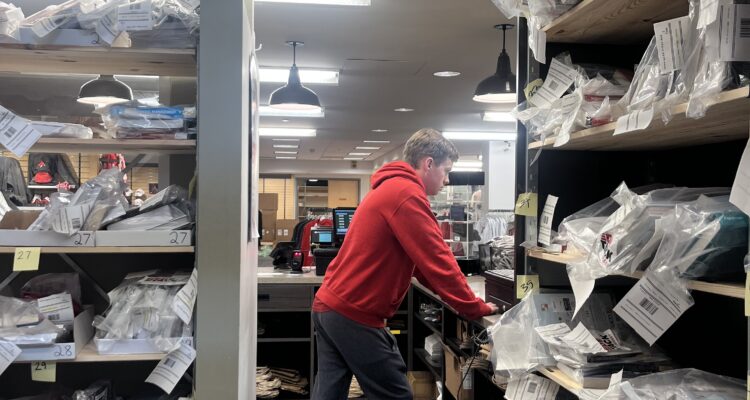
Acquiring textbooks has long been the great bane of many college students. They are almost universally expensive, often difficult to find, and frequently quite unwieldy. But have no fear, Stags! Red Stack Direct, Fairfield University’s newest textbook program, purports to make this struggle a thing of the past. From this day forward, no Fairfield student will ever have to worry about finding affordable textbooks ever again. The eternal struggle is over!
If only that were the case. I, dear readers, have the regrettable task of informing you of something many of you may already know. Red Stack Direct is not the best option. It is, in fact, not even a particularly great option, and, is most likely, just another way of profiting from the student body.
“How can this be?” you protest. After all, Fairfield claims the program offers 30-50% cost savings, which, if true, would be incredibly generous. “Where do they claim this?” you ask. On the front page of the Red Stack Direct website.
Let’s break down that claim. For my classes, I had to purchase six texts. I purchased four of them digitally, and the remaining two were ordered from Amazon. I spent just over $200, including priority shipping on both physical texts.
Red Stack Direct, on the other hand, charges a fixed rate of $24 per credit hour. Keep in mind that for each semester, most Stags take five courses, each worth 3 credits. And while many classes no longer require textbooks, Red Stack will still charge for those courses. In that sense, students who require only two textbooks still have to pay the full price, when they could have spent a mere $80 and been set for the semester. Now imagine doing that every semester, for four years. It is a lot of wasted money.
The other claim that Red Stack makes is their alleged flexibility. Now, they do guarantee that students who change their class schedule can exchange books, and this is a good deal, but in what other way are they flexible?
Certainly not in the structure of their textbooks. Anyone who has received one of their heavy, loose stacks of textbook pages can attest to that. Binders for those textbooks are, by the way, not included. It is your responsibility to keep those stacks together and return them promptly at the end of the semester.
“What if I have a continuation class?” you cry out. In that case, you still have to return your textbook, only to be issued it again at the start of the next semester. Flexible, this is not.
But back to those unwieldy, physical textbooks. Those who purchase their textbooks, as I did, do not have that struggle. As with every other program used by the school, our textbooks are digital. They do not have to be returned at the end of the semester. They cannot be damaged. They cannot be lost. They are available from the moment they have been purchased, which can be done in the comfort of your own dorm, or in the midst of your very first class of the semester.
Is Red Stack Direct a concerted effort to relieve students of their money? I can’t be sure. Is it more expensive, less convenient, and more frustrating than simply buying your own textbooks? That, I have the displeasure of reporting, is very much the case.
I would remind you to opt out, but the window for that has already passed. Better luck next semester!
Leave a Reply