
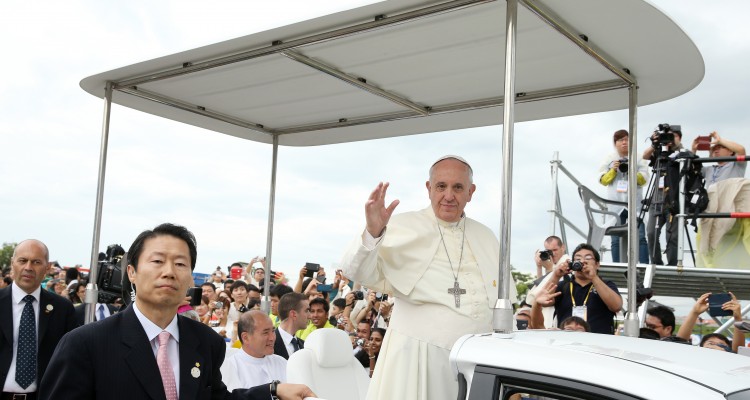
On April 12, 2015, Pope Francis led an Armenian-Rite Mass in recognition of the widespread killings of Armenians under the Ottoman Empire during the early 20th century. April 24, 2015 will mark 100 years since the mass killings of Armenians ensued. I believe that the time has never been more right for a respected world leader such as Francis to recognize the horrors that occurred a century ago. By recognizing that Ottoman Turks committed an act of genocide, Francis is also showing the world that ignoring the lasting impact that these horrors had and continue to have on the Armenian people will not be tolerated.
After learning that Francis referred to the senseless slaughter of Armenians by Ottoman Turks as “the first genocide of the 20th century,” urging the international community to recognize the slaughter as genocide, I knew that there would be displeasure expressed from Turkey. Stating that the “slaughter” was in fact genocide was necessary for the sake of the Armenian people. Francis was correct in saying that “Concealing or denying evil is like allowing a wound to keep bleeding without bandaging it.” Although the time has passed for accountability from the original perpetrators of the Armenian Genocide, international recognition of the severity of the events is imperative, allowing those whose ancestors suffered or perished during this horrific period to gain a sense of closure.
Genocide, according to Raphael Lemkin who coined the term in the early 1940s, is “intended rather to signify a coordinated plan of different actions aiming at the destruction of essential foundations of the life of national groups, with the aim of annihilating the groups themselves.” Regardless of whether the destruction of a group is in part or in whole, the destruction, according to Lemkin, constitutes as genocide; and when coining the term, Lemkin was acknowledging the aftermath of what happened to the Armenians. Therefore, Francis’ declaration that the murder of the Armenians was a genocide signifies an important recognition that the murder of these people was not senseless or the result of civil strife, as many try to pass the events off as. Rather, the genocide must be seen as a systematic extermination of a minority group of people.
By raising international awareness of the importance of acknowledging the Armenian Genocide, Francis is also calling attention to the final stage of The Ten Stages of Genocide. The stages, composed by the President of Genocide Watch Gregory H. Stanton, are composed of the actions that cause genocides to occur between the oppressed and the oppressors. The final stage is denial. Francis’ stance opposing the continued international denial of the genocide shows that there must be accountability for the inhumane actions perpetrated against the Armenians. Turkey in particular remains stuck in the final stage. As a result, despite the small number of 23 countries that acknowledge the Armenian Genocide as such today, the remaining countries around the world, including Turkey, will continue to prevent the Armenian people from achieving closure.
Francis should be lauded for his refusal to ignore history, and others, especially world and other religious leaders, should follow suit. Ignoring history allows ignorance and denial to perpetrate, resulting in the continuation of the occurrence of genocides with the notion that if a country is considered to be a powerful-enough ally, that country can deny its actions. One only has to look at past genocides such as the Holocaust in Europe and ongoing genocides such as that which is currently occurring in Darfur, Sudan to see that ignoring the Armenian Genocide only serves to strengthen and protect those perpetrating more recent genocides.
Despite Francis’ significant acknowledgment of the Armenian Genocide, his words are not enough. Action must be taken with the knowledge that change will not be immediate regarding how countries around the world perceive the events of a century ago. There are still countries, such as our own, that do not refer to the Armenian Genocide as such because they fear that Turkey will be lost as an ally if they do so. While having a relationship with Turkey is crucial to international relations, it is not permissible to ignore history and to fabricate the number of Armenians affected by the genocide, including those who lost ancestors. Even now, nearly 100 years later, Turkey continues to deny the magnitude with which Ottoman Turks systematically persecuted Armenians, claiming that the statistic of 1.5 million Armenians murdered throughout the genocide is an exaggeration.
Furthermore, by choosing to deny the events of the Armenian Genocide and refusing to discuss what happened to the people affected, the cold words of Adolf Hitler ring true when he said in his Obersalzberg Speech: “Who, after all, speaks today of the annihilation of the Armenians?” There is no excuse for Hitler’s words to be truthful and the time has come to prove his words wrong. In not doing so, we then fail to ensure the safety of current and future groups of oppressed people who, like the Armenians, are targets of systematic persecution.
Leave a Reply