
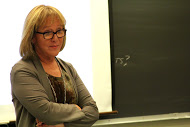
Photo by Atdhe Trepca/The Mirror
Fairfield University journalism professor Susan Antilla said she was a troublemaker while attending a private, all-girls Catholic high school. A newspaper advisor told her she had no talent and rejected her from joining the newspaper.
Now, her résumé lists that she is an award-winning writer, a freelance journalist for The New York Times and Bloomberg, and most recently, an educator.
Antilla’s story is the story of a woman who is always advancing, always moving and never taking no for an answer.
Born in Westchester County in New Rochelle, Susan Antilla said it “didn’t take much to get in trouble” at The Ursuline School.
“We weren’t doing anything really, really bad. Just smoking in the girls’ bathroom …” said Antilla.
She claimed that writing was something she always knew she wanted to do.
“I don’t think I ever thought of doing anything else other than writing. I wish I could point it to some specific thing … but I always liked writing from when I was little,” said Antilla.
While attending The Ursuline School, Antilla knew she had to be involved in the best way she could be: writing for her high school’s newspaper. Though, when she approached the faculty advisor about writing for the paper, Antilla was rejected.
“She looked at me and said, ‘Absolutely not, you have no talent.’ That was that. I didn’t get to work on that paper,” said Antilla.
She later attended Manhattanville College. She found the existing newspaper “a little boring,” nor was she impressed that it printed “whatever the administration told the reporters.”
Instead of being passive, she decided to create her own student newsletter called Periscope.
“I would type it myself … Take it to a mimeograph machine … run around campus and drop them off,” said Antilla.
After graduating from the New York University graduate program for journalism, Antilla worked at Dun’s Review, “a business magazine written for business people,” said Antilla.
Although she gained experience and knowledge about journalism at this magazine, she felt a similar dissatisfaction with working for Dun’s Review.
“The people reading this magazine, they didn’t need me … I felt the average member of the public needed information about business much more than business needed information about business,” said Antilla.
Antilla found what she was looking for when she was offered to write a story about USA Today, which was just launched by Gannett Company. She had finally found a newspaper whose philosophies on business writing coincided with her own. Today, USA Today reaches more than 3.2 million readers daily.
“Everybody was making fun of Gannett for this idea. You know, ‘a newspaper that was written for the average person. Like, who cares about the average person?’ and I thought, that was a great idea,” said Antilla. Eventually, she sent her résumé to USA Today and landed a job.
After 34 years working as a journalist, Antilla claims that the most surprising thing about the world of journalism is forces working against journalists.
“If you do anything investigative, there are a lot of forces that work against you – corporations, people on Wall Street. There is a lot of pressure from business to keep a story from getting out,” she said.
Whether the forces were the administration at Manhattanville or people in business, Antilla said kept pursuing the truth and what she believed in.
Her book, “Tales from the Boom-Boom Room,” details exactly that aspect of her life. In the book she exposes the consistent mistreatment of women on Wall Street.
“I can tell you the exact moment when I decided I had to write a book,” she said. “I was sitting in the newsroom at Bloomberg. The [Smith] Barney case, I had broken that story, and it was getting a lot of publicity … I had opened The New York Times Magazine and I saw a full page glossy ad talking about how wonderful Smith Barney was to women. At the same time I’m seeing all of these press releases on how they’re doing special seminars to educate women about breast cancer.
“And I just got furious,” Antilla said.
The reason Antilla was furious was because in the aftermath of the Smith Barney story she mentioned, which detailed the mistreatment of female employees on Wall Street, Smith Barney was getting the exact opposite type of publicity from the media.
“They’re terrible to these women and they’re getting all the reporters to write their stories, profiling their women brokers. That was when I said I gotta write a book and tell these people how it really works and what really happened,” said Antilla.
Antilla opened up about a woman who inspired and motivated her, Judy Vladeck. Vladeck was a lawyer who was especially active in representing women who were suing brokerage firms. Antilla described an experience with Vladeck that still resonates with her. It was during the turmoil on women’s treatment on Wall Street that women from Smith Barney came in to see Vladeck.
“She sat down in the room with them and she looked at them and she said, ‘I’m so excited that women are getting angry again,’” Antilla said.
Antilla’s resilience can’t be pinned down to an event, a story or an investigation. It can’t be held up or examined and even at the end of the interview, it was difficult to discern the origin of Antilla’s relentlessness. Though in respect to Antilla’s impact on Wall Street and moreover, to her history of persistence, the origin can be pinned down to what Antilla learned from Judy Vladek.
“Doing the nicey-nice thing with a company that allows discrimination and harassment doesn’t work. I think you gotta get tough, and [Judy] was really tough. She was really one of the most impressive people I’ve known in my career. Judy was really a force of nature,” said Antilla.
Leave a Reply