
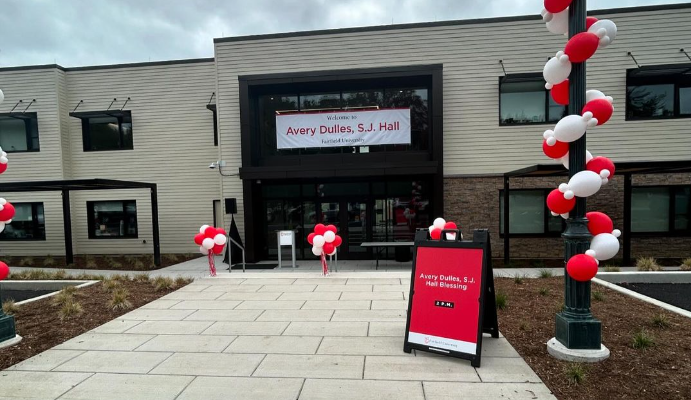
With enrollment skyrocketing, Fairfield University has been building housing at an unprecedented rate. Soon enough, they may even have to build more classrooms. But how have their recent projects affected the feel of the campus? From McAuliffe Hall to the new student residences, the campus has a wide range of architectural styles. Some of these styles work, others do not. I, dear readers, am here to share my two cents on the matter.
In this writer’s opinion, there are a few buildings that comprise the gold standard Fairfield should be aiming for. Dolan Hall, with the attached Dolan House, and Bellarmine Hall are obvious standouts, but the Barone Campus Center and the Dolan School of Business are also great designs. Why do these work? The first two are stately and impressive. Distinguished stonework and windows that offer some of the campus’ most stunning views. They practically scream higher education. The latter two are sleek and modern, but still timeless, welcoming students and guests alike to a 21st-century campus. They represent the two paths the University should be taking when building. Either stick to the classics, or, if going the modern route, do it right.
Have they achieved this?
Yes and no.
The most recent residence halls are a perfect example. Dulles Hall is the better of the two. At the very least, it matches neighboring Faber Hall, which, for those who haven’t seen it, is one of the few residence halls that does not have brick siding. There’s a theme. Consistency. As far as residence halls go, it works. Although, living inside the building is a little less desirable, as one of our other writers has noted. That’s the good. Bowman Hall, attached to the Quad, is the bad, or perhaps the ugly. Luckily, most people never have to see it, as it is almost entirely hidden behind Regis. But for those unfortunate residents of Jogues, such as myself, it is something of an eyesore. The pattern of bricks is reminiscent of house wrap. It feels unfinished. Bland. Corporate. Rather than a complex pattern of bricks, like Gonzaga or Regis, they went with a handful of dark bricks within a sea of beige walls. Unlike the other residence halls, there isn’t anything to break up the shape of the building, either. It’s a beige cube with windows. The only good thing that can be said about it is that it makes Loyola look less terrible, so long as you forget the lack of air conditioning inside the place.
As new buildings go, the best of them is by far the Leo D. Mahoney Arena. It’s impressive, which, with a price tag to the tune of $51 million dollars, is somewhat expected. Note the sweeping steel ceiling beams in Stag red. Note the colossal air ducts that are somewhat reminiscent of a spaceship. Note the massive half-arch at the front of the building. Note that, unlike Bowman Hall, the brick pattern is complex and interesting, which breaks up the huge walls and prevents them from becoming an eyesore. Perhaps my only complaint is that, with 3500 seats, the building can’t seat the whole student body, but with space a consideration, even that is a trivial matter. It is a genuine pleasure to watch games within the Mahoney Arena, and it is a worthy addition to the campus.
What I can say is this: many students, particularly in their early years on campus, see very little of Fairfield. It’s easy to fall into a routine, walking the same paths every day from your dorm to your classes and back again. So much of the campus is out of the way, that it is not hard to miss things. When you have the time, give yourself a tour. Eat lunch on the porch of Bellarmine Hall. Walk through the zen garden hidden between the trees. Check out the Dolan House. There are some exceptionally beautiful spots on campus. You just have to look for them.
Leave a Reply