
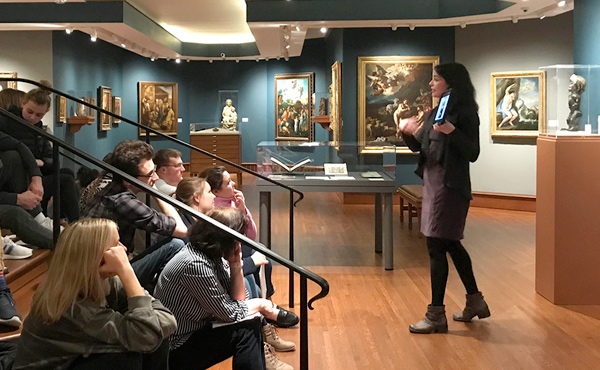
Fairfield University has its very own art museum here on campus!
Bellarmine Hall galleries feature a wide collection of art from different cultures and time periods. This fall semester, the galleries are presenting a unique exhibition called “Ink and Time: European Prints from the Wetmore Collection.” These pieces have been accessible to see since Sept. 12 and will stay open until Dec. 21 of this year.
The prints reflect the Baroque and Renaissance time periods, and this is only the second collection of artwork featured in Bellarmine that has been created alongside Fairfield Undergraduate students. In Executive Director Carey Mack Weber’s Foreword, she mentions that Connecticut College has shared the art prints with Fairfield for this exhibition.
Before Connecticut College had access to these prints in 1930, Fanny Wetmore spent years during the early 20th century curating the collection of engravings and woodwork from the 15th through 18th centuries. With the growing market and more technological advancements, printmaking became more popular and more profitable. Prints were popular for museums in that time period because it was easily transportable and also a newer form of visual art.
The engravings and wood prints featured are from artists such as Jacques Callot (French), Giulio Bonasone (Italian) and Albrecht Dürer (German) to name a few!
Jacques Callot’s style of etching is featured in his art print “The Assumption of the Virgin” which was made in the 1620s. He is attributed with the creation of the èchoppe tool. Callot’s art features his openness to new experiences in etching like “double-biting” where lines are made by transferring metal to acid on a plate to construct the image. The image produced for this piece is very tiny compared to some of his other works.
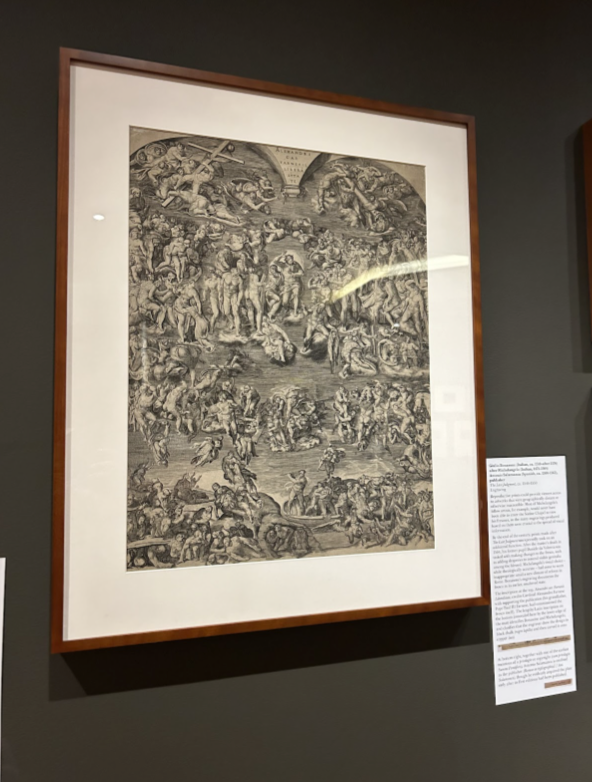
The story behind Michelangelo’s/Giulio Bonasone’s “The Last Judgment” is an interesting notion to be attributed to this piece, which was curated over the years 1546-1550. The visual decisions Michelangelo made were not aligned with the reform happening in Rome. His engravings were accurate in a theological sense, but Bonasone’s added engravings date back to the “unaltered state”. The Latin inscription in the print recognizes both Bonasone and Michaelangelo.
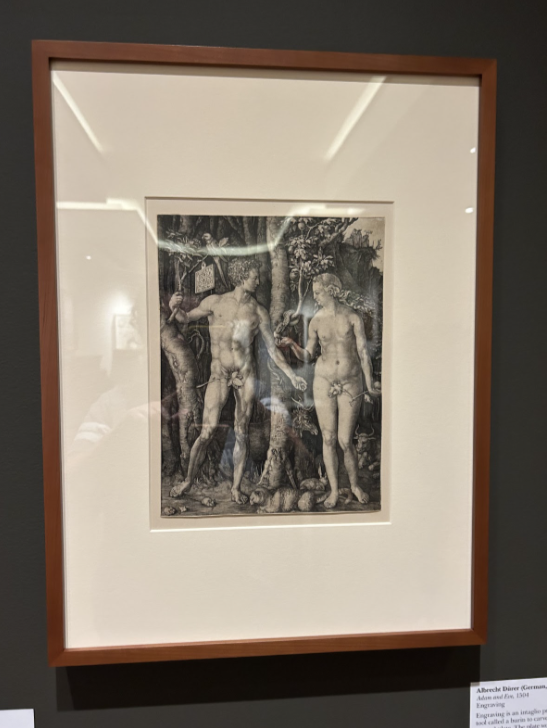
Dürer’s “Adam and Eve” engraving from 1504 is notable because of the new type of carving process used called “intaglio.” The print is created by incision into a metal plate. The artwork of “Adam and Eve” was produced because Dürer had been interested in the proportions of the natural human body. The added tree in the print is a homage to his signature style and Italian journey.
Printmaking is still an art form that is prevalent today! There is now a large scope of ways printmaking can be created. Besides the old-fashioned ways of engraving and etching, prints can be generated on digital platforms.
Make sure to check out Bellarmine Galleries before the semester is over! To find more information on “Ink and Time: European Prints from the Wetmore Collection,” check out https://www.fairfield.edu/museum/ and https://www.fairfield.edu/museum/ink-and-time/.
Leave a Reply